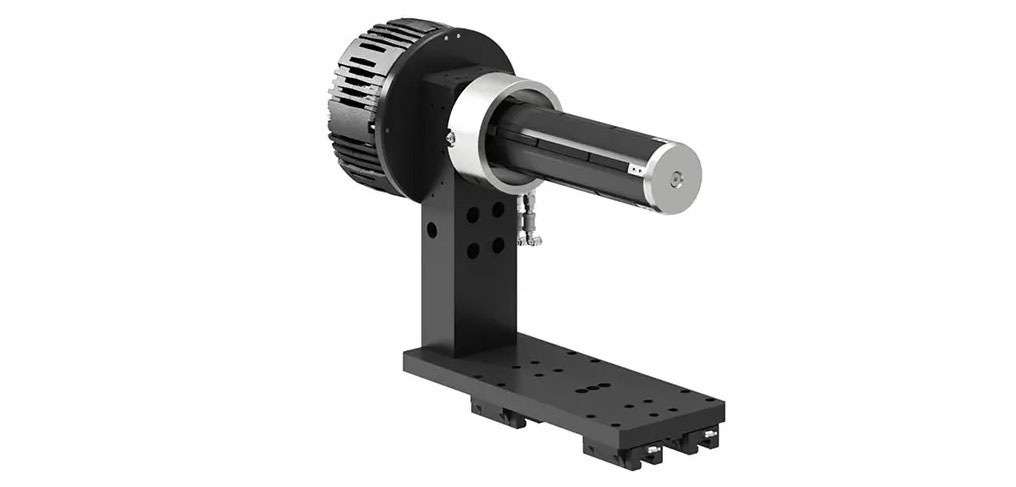
The foil unwinders from WPR are a clear example of how quality can look down to the last detail. Foil holders appear to be an inconspicuous component, but on closer inspection we discover many important technical features that have a significant impact on the quality of the lamination process.
Compared to traditional foil holders on which the film rolls are fixed with flanges, WPR’s foil unwinders are highly developed precision components that are specially designed for the requirements of foil lamination.
Secure fixing of the foil rolls
During the laminating process, the rolls of decorative foil must not slip sideways under any circumstances, as otherwise they cannot be aligned to the profile. They must also be clamped tightly to prevent slippage. Jerky variations in tension lead to unacceptable defects in the film on the profile. For this reason, WPR only uses a pneumatic expanding mandrel to fix the foil rolls on the unwinding axis. The blocking of the foil roll is triggered by a central switch.
The basic version of the foil unwinders has a diameter of 76.2 mm (3 inches), the standard internal diameter for PVC window foils. Decorative foils and papers for the furniture industry are often supplied with an internal diameter of 152.4mm (6 inches). WPR has developed an easy-to-install adapter for this, so that you can process foils with both inner diameters on the same system without having to install different foil unwinders.
The foil brake determines the quality of the foil application
One of the most important components in terms of the correct processing of decorative foils is the foil brake of the unwinder. It must deliver the right braking force required at any given moment. This changes continuously as the foil is unwound. While the full foil roll already has a braking effect due to its own weight and inertia, the force of the foil brake must increase during the unwinding process in order to prevent the film from unwinding slackly or in an uncontrolled manner. At the same time, there must be no excessive tension on the foil, as this could lead to stretching or even tearing. Defects caused by excessive foil stretching are particularly treacherous as they are not necessarily immediately visible. Any micro-cracks that occur can make the protective top layer of the film permeable to water and cleaning agents. This leads to unsightly surface defects, which usually only appear after delivery to the end customer. Customer complaints are not only annoying but can also result in very costly repairs, e.g. in the case of a series of windows that have already been installed.
The intelligent foil brake for foil lamination
WPR has developed an exclusive braking system for decorative foils to prevent damage and issues with the foil from the outset. It is a multi-stage pneumatic brake whose stages can be activated or deactivated as required. The flexibly mounted brake pads prevent the brake from stuttering and guarantee even braking performance even when the brake pads are worn or worn on one side.
The great advantage of this system is that it also provides a precise and sensitive braking effect in special cases such as very narrow or thin foils, but also at very low working speeds, without damaging the film. An excellent foil brake is not characterised by its maximum power, but by its sensitivity and precision in the lower tension range.
Although WPR can also supply alternative braking systems such as magnetic powder brakes on request, they are more expensive and may not be able to build up a magnetic and therefore braking effect if the minimum rotation speed is not reached. In these cases, the pneumatic film brake from WPR has proven its worth.
Automatic brake control
As the necessary brake tension changes continuously during the unwinding process, the foil brake must be continuously adjusted to guarantee uniform film tension. This can be done using an optional automatic brake control, which controls the braking power in relation to the amount of foil remaining on the reel. This means that the system operators do not have to regulate the foil tension manually, but can rely on the automatic adjustment of the foil brake. This system can also be supplemented by an acoustic alarm at the end of the foil. This alerts the operators of the laminating machine to the approaching end of the foil roll. This allows them to prepare for a foil change in good time.
Multiple foil unwinders
One advantage of foil lamination as a colouring process compared to powder coating, for example, is that colour changes can be made during the process without stopping the machine. This is made possible by multiple foil unwinders, on which the various foil rolls are already mounted on the machine and then changed between the foil rolls on the fly.
Foil changes can be carried out manually by experienced system operators, but automatic foil changers, which can position the foil connection between two foil ends in the gap between two profile bars, are more reliable. This means that no material is wasted, and no additional bar is required for the foil change. So called automatic foil splice systems usually work with two foil holders, but up to four foil unwinders are also possible, which are mounted on a rotating disc. This allows a wide variety of decors to be processed one after the other.
Retrofitting on old machines
Another advantage of the foil unwinders on WPR wrapping machines is that they are mounted directly above the slot nozzle glue head and can therefore be easily aligned with the glue application. A handwheel with position indicator helps the operator to align the foil in relation to the glue head and the profile in a few simple steps. WPR also offers the retrofitting of modern foil unwinders and braking systems on old lamination machines. With a complete upgrade, it is also possible to install the entire hot melt support unit, including the foil holder, on a profile wrapping machine from another manufacturer. Look at our website for UPGRADES or contact us directly using the contact form below. We will then discuss all the technical details together.